Balance, boundaries, and burnout: workplace metaphors in the time of alienation

The current threats to jobs and livelihoods posed by AI, whether real or imagined (my bet is on real), expose deeper issues with our relationship to work and the role it plays in our lives. When positioned within the long history of alienation, AI-saturated workplaces are not a disruption, but rather a kind of logical terminus where our labor is no longer owned, performed, or understood by us. In this comeback post, I'm going to explore some of the metaphors that got us here and that keep us stuck on our tragic trajectory.
Balance is a scam
Work-life balance has become a kind of "common sense". It is what we are told to aspire to because defining ourselves solely by our career is obviously bad. And, obviously, we want and deserve enough time outside of work to play, and be with family, and lounge around eating chocolate. We, the workers, are told that achieving this balance will allow us to feel successful in all domains of life. They, the bosses, are told that this balance makes them more money by making us more productive and compliant workers (okay, they usually don't say the word "compliant" out loud, but it is what they mean by things like "self-motivated").
We, the workers, should be suspicious of this win-win. So, I'm going to argue against this "common sense".
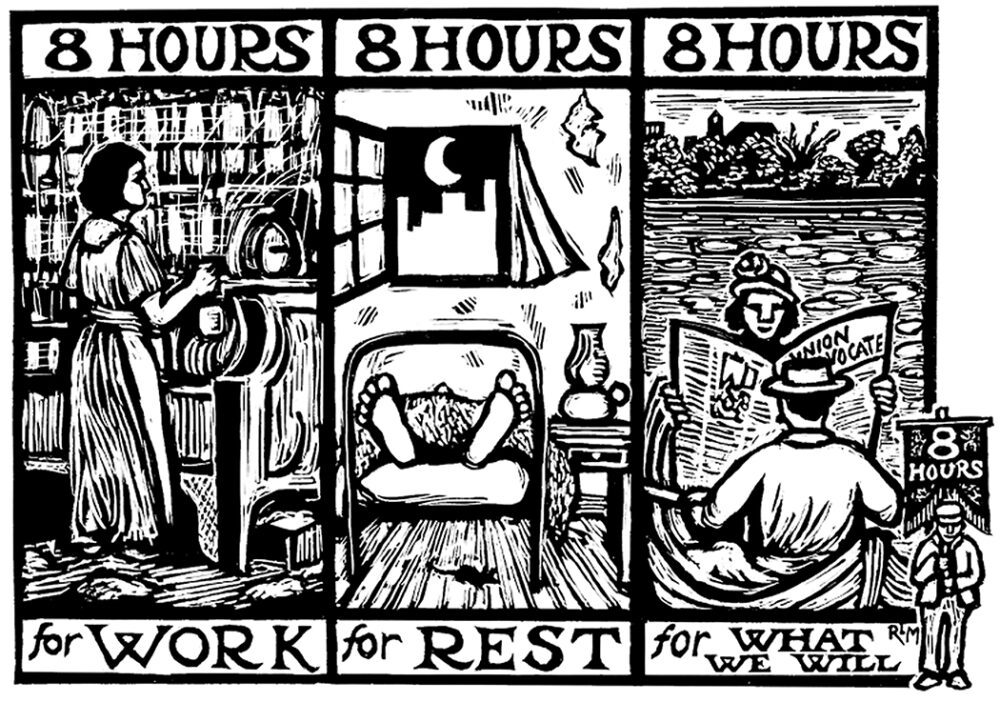
The eight-hour workday is a too-perfect representation of the work-life balance metaphor. So perfect that it's gotten us very very stuck. Hours, as metaphoric objects to be stacked and weighed against each other, are perfectly balanced between work, rest, and leisure. It puts numbers to our pursuit of happiness, and once numbers get involved it's hard to go back and argue about things like premises. For example, is an hour at a job we hate, that drains us and leaves us emotionally exhausted, really the same as an hour spent walking in the woods or cleaning the house? That discussion, under the eight-eight-eight mindset, is already off the table.
And because eight-eight-eight is an undeniably mathematically-sound kind of balance, working less than eight hours a day becomes radical. Trying to claim more than eight hours for ourselves would actually upset the balance we've come to value so highly. So Keynes' 100-year-old promise of a 15 hour work week? Yeah, that's actually bad under the work-life balance metaphor.
There's a deeper premise still, out of reach once the balance metaphor is accepted. Work and life are separable objects. In other words, work is not a part of your life. Just let that sink in for a moment. The time you spend at work does not count as the time you spend living your life. That is crazy. And that it is not commonly recognized as crazy, makes me feel crazy.
We sell off a third of our day to "work", aren't conscious for another third, and are somehow okay that we're left with only a third to do "as we please"* (*in actuality, a lot of that final third is eaten up by all of the real life work we need and want to do). It's a total scam. And our buying into this separation between a thing called "work" and a thing called "life" is what makes us so susceptible to falling for it.
Then there are the down stream effects to this separation. Because once we make a virtue of separating "work" and "life", we have to define them in such a way that legitimizes the separation.
First, the conceptual separation of "work" and "life" likely reinforces the de-valuing of domestic labor (which in turn supports the mechanisms of gender-based oppression). The concept of work-life balance seems to be traceable to the mid-1800s, when the roles of women and children in the workforce were being increasingly scrutinized. Capitalists wanted their labor, but also needed the reproductive labor (almost entirely done by women) to ensure a consistent workforce. Balance had to be struck between exploiting the productive labor of women and children, while also ensuring sufficient time for reproductive labor, i.e. for women to raise the next generation of productive laborers. Reproductive labor remained a central motivation for the work-life balance trend as it gained traction again in the post-war era. This is when progressive ideas like family leave began to be codified into law. And when we talk about balance today, the family is still front and center.
Those are good things, right? Right. BUT they also smuggle in a legitimization of the division between care-oriented work (i.e. reproductive labor) and wage-work (i.e. productive labor). If we need time outside of work to do care work (i.e. "spend time with family"), then care work isn't "work". This results in de-prioritization of material support for domestic labor (e.g. what could be achieved through Universal Basic Income) and suppressed wages for wage-work that looks like domestic labor (e.g. nursing, teaching, and social work). Not good.
Second, if "work" isn't a part of "life", and we're only left a few precious hours for the "life" part, we probably want to make "life" look as little like "work" as possible. That's bad. Like really bad. Because the kinds of things that make our lives meaningful are very often hard. So forget all of that self-actualization stuff, the reading, the hobbies, the volunteering in our communities. That is too much like work. Instead, bring in pleasure, bring in leisure, and bring in ease. We're drawn to hedonism. We consume. We scroll. We binge watch Netflix. (Byung-Chul Han has interesting things to say about this in The Burnout Society and Capitalism and the Death Drive)
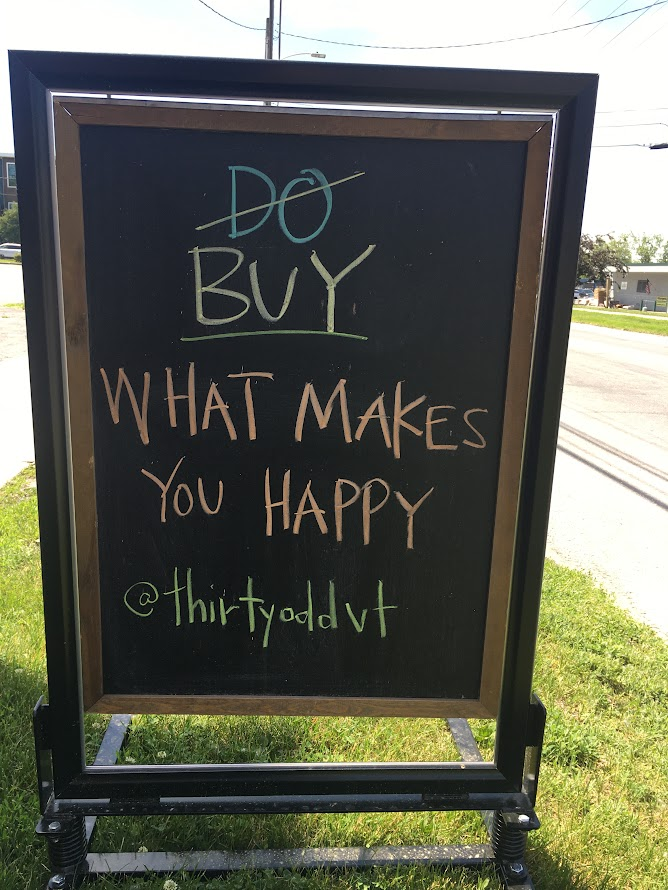
To be clear, pleasure is great. There should be room for pleasure in life, for a good lounge in the sun. But if that becomes what "life" is, we lose all kinds of means to individual and community empowerment.
Interim TLDR:
- Work-life balance creates a natural limit to our right to claim time for "living". Anything less than a forty hour work week becomes radical, a way to upset the balance. That's a bad thing.
- Because of the centrality of "family time" to arguments around work-life balance, the metaphor delegitimizes care work as work. That's bad too.
- The separation of "work" from "life" results in a valuing of consumption, as we seek to make our "life" look as little like "work" as possible. This discourages the kind of real work that leads to self and community empowerment.
Boundaries and the severing of the self
We achieve work-life balance by setting and maintaining boundaries. Don't check your work email on the weekend. Don't think about Friday's deadline if it's after 5pm. We're satisfied when we can say that we can just "close the laptop and go home". It's become a kind of modern self-care mantra.
Underlyingly, balance and boundaries arise from different basic metaphors. Whereas balance is all about conceptualizing abstract things as objects to be weighed against each other, setting boundaries is spatial. We divide our world into spatial regions of "work" and "life", often, but not always, related to different literal spaces. Still, these two metaphors reinforce each other by both valuing separation.
In the previous section, I think I ranted enough about the harms of keeping "work" out of "life". So, here I'll focus on the problems with keeping "life" out of "work".

To be good employees, we are expected to leave our personal problems at home, and our passions, and most definitely our politics. We've sold our labor hours to our employer and in doing so have forfeited the right to determine pretty much anything about what those hours are like. Talking about our lives or, god forbid, talking about how to make the workplace better for workers, becomes a direct violation of the agreement we've made with our employer.
The thing is, my fears and anxieties, my hopes and daydreams, they don't just magically disappear because some employer has bought my time. Until Severance becomes a reality, I am still living my life. Even if I'm at work and my employer would rather I forget that. Even if my employer so kindly offers me a "company doctor" to try to teach me how to compartmentalize and repress in the name of productivity.
If you're thinking at this point "but what's so bad about that? I want to do a good job!", I'm sorry to tell you that you've been duped. Your employer and the culture that enables his existence (yes his, employer-employee relations and male supremacy are related) has successfully convinced you to equate your inherent desire for self-actualization (good thing) to being as productive of a worker for him as possible (bad thing).
What's the alternative, you ask? Emancipatory education can offer us a hint.
Critical and emancipatory approaches to pedagogy, such as those advocated for by bell hooks and Paulo Freire, embrace the inclusion and participation of a student's whole self in the classroom. Instead of the classroom as a space separate from the student's life, it is re-conceptualized as a space within a student's life.
This is a radical departure from traditional modern western pedagogies that demand that absolute authority is granted to the teacher (much like the authority demanded by our employers, which is no coincidence. But that's for a future post). The valuing of efficiency (e.g. learning and then regurgitating as much information as possible, as quickly and accurately as possible) is replaced by a valuing of effectiveness, which, crucially, is co-determined by the students. The strict lesson-assessment structure is loosened, giving room for students to direct course material toward things that are personally relevant. An "effective" class is then one in which all students learn new ways to navigate their world and progress toward their goals (not the world and goals of a teacher or employer).
So how can this be extended to the workplace? The goal of the (prototypical) workplace under capitalism is non-negotiable: make profit for the employer. So there are two things we can try to do: (i) try to sneak our lives into the workplace anyway, and (ii) transform the workplace by changing the employer-employee relation.
The sneaky route first. For a brief period in the 1800s, 'readers' in Cuban cigar factories were all the rage (shout out to Gabriela Garcia's beautiful Of Women and Salt for directing me to this history). In almost every cigar factory in Cuba, you could walk in and hear someone reading out from the daily newspaper, or a book of poetry, or an epic novel, as workers rolled cigars. And, most importantly, both the reader and the reading material were decided on by the workers themselves. The workplace then became a simultaneous site of exploitation and self-determination. Yes, workers had to meet often grueling quotas. But at least they were doing so while learning things they found personally meaningful and relevant (and that was often some pretty radical stuff). Their labor was the employer's, but their time was, at least in part, still theirs. The "work" place was also a "life" place.
Of course, when the Spanish crown learned that workers were opting for leftist political education on the job, they quickly moved to shut the practice down. There are people now working to revive the tradition, but it's an uphill battle. In small workplaces, where the employees actually know the employer and can still appeal to their humanity, things like this may still be possible. But they are damn near impossible in large corporate workplaces where surveillance is fast approaching omnipresence (have you heard about emotional surveillance yet? It is horrifying).
Okay, what about transformation? At this point, with the consolidation of power and wealth into the hands of so very few, transformation is the only thing that will save us. But I have one more metaphor to talk about first.
Burnout: from too much meaning to no meaning at all
Last one (if you're still here, that's incredible. I hope you're reading this "on the clock" ;) ).
Burnout. It's become ubiquitous. If you haven't experienced it yourself (how?!), then you almost certainly know someone who has. But how we use the term now has shifted significantly from its earlier uses. And I'm going to argue that this shift is related to a loss of purpose and meaning in what we've come to call "work".
The earliest references to burn out in English are poetic (still with a space in those days), used as a deliberate metaphor relating spiritual and emotional exhaustion to the dying of a flame (e.g. Shakespeare, The Passionate Pilgrim, 1599). It entered into psychology as an academic construct between the 1960s and 1970s. The first case studies, importantly, were from care-work (e.g. social workers, healthcare professionals, and drug clinic volunteers). Again and again, social psychologists saw people who cared deeply about their work lose their sense of motivation and purpose, as the stress of the job wore down the commitment they had once so deeply felt.
To be sure, burnout is still used for these cases. They probably even remain the prototypical case. But we also use it when we become exhausted and cynical and detached from jobs we never particularly cared about in the first place. Which begs the question, if we weren't passionate about the job to begin with, what is it that we are burning through?
David Graeber can help us out here (so can Byung-Chul Han again, but his writing is less fun). Here's Graeber's basic proposal: something about our modern economy has led to the proliferation of "bullshit jobs", defined as jobs that are, by workers' own assessments, meaningless. Through this proliferation, the bullshit also seeps into jobs that were once meaningful (e.g. education), such that more of a worker's time is spent doing tasks that do not contribute in any perceivable way to the meaningful work they thought they were there to do. Graeber argues that this constitutes a kind of spiritual and moral violence. We, as social humans, have an inherent desire to perform meaningful work. And when the ability to perform meaningful work is taken away from us, we are harmed.
The broadening of our use of burnout is directly related to this process of bullshit proliferation. Professional burnout began as an exhaustion that resulted from our passion and commitment meeting the physical limits of our material circumstances (e.g. austerity measures, a lack of support structures, a lack of access to physical and mental healthcare). Now professional burnout is a result of our continuous search for meaning where there is none.
We need meaning and we need to work. Under capitalism, that work is determined by our employer, not ourselves or our communities. And our employer doesn't give a rat's ass about ensuring that what we do is meaningful to us. In fact, it's in their interest to ensure that we don't derive personal meaning from our work, because then we might begin to want things like more autonomy and access to decision making, which would surely cut into their profits.
We're exhausted by an endless search for meaning in an increasingly barren workscape.
Interim TLDR (2):
- We've bought into the value of setting boundaries between "work" and "life" and in doing so have taken away our right to bring our lives into the workplace.
- If our personal lives are excluded from our work, so is our personal pursuit of meaning.
- Because our desire for meaning is an inherent part of being human, our inability to derive meaning from work is spiritually, psychologically, and physically harming us.
Alternatives to alienation
So, bullshit is everywhere, ever-reducing our ability to derive meaning from our life and labor. Wealth concentration and workplace surveillance prevent us from trying to counter this process "from the inside". That means we need transformation.
How? Two words: employee ownership. And a third, to make that type of ownership more possible: unionization.
If we want to have the kind of control over our work that enables us to make it genuinely and truly meaningful (for us, not our employer!), then the absolute authority of the employer over employee work conditions has to be resisted.
The good news is, we already know how to do that. Unions have a long history of resisting employer domination, demanding worker autonomy, and getting workers a seat at the negotiating table. And, after a long decline in union power under neoliberalism, it seems that the tides are turning in favor of unions once more. At the same time, we are seeing growing interest in employee-owned businesses, where the negotiating table is made up entirely of the workers. In these models, workers no longer need to compromise their autonomy to satisfy the greed of an employer. In these models, we gain full control over what our work is and for.
The bad news is, the unprecedented concentration of global wealth and power that define our moment is going to make changing these norms of domination really really hard. I'm hopeful though. Really, I am, despite everything. Because in our absolute desperation for meaning, I think we are more prepared and more willing to do the hard work.
Bread & Roses
I don't want work-life balance, I just want life. I don't want work-life boundaries, I want my work to be beautifully interwoven into all that I do and value. I want bread and I want roses and I don't think I should have to sell off a third of my life to get those things.
We are born to work. Work is our power. It is where our agency lies. It is where meaning is made and found. But all of that is only true if we are working for ourselves and our communities. And we can do that. We've done it before, people are still doing it now, and we can make it the norm. But we have to do it before we all burn out.
It's going to take a lot of work. So, join a union and get actively involved in your union's organizing efforts. Start a worker-owned cooperative. Keep reminding yourself and everyone who will listen that our work is ours, not theirs.
Solidarity forever 🍞🌹
Schuyler
All of our work is 100% human-made and 100% free. Forever. But doing this work isn't free for us. So if you'd like to support us, and especially if you feel that you got something valuable from reading this piece, please consider leaving a tip.