Judicial Independence Is the Crown Jewels of American Democracy
...according to US Supreme Court Chief Justice John Roberts (and Rehnquist before him).

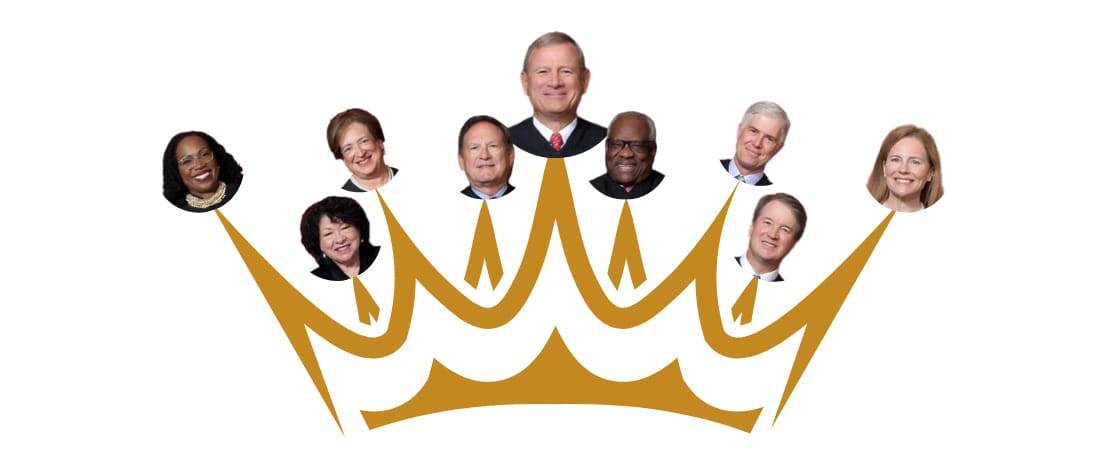
The Fragile State of American Justice
The United States justice system is often held up as a pillar of its democracy, but it finds itself increasingly scrutinized for its role in shaping society. From high-profile Supreme Court decisions to ethical controversies involving justices, the judiciary's image as an impartial guardian of the law is under strain. Public trust in the courts has eroded amid concerns over political influence, ethical lapses, and decisions appear disconnected from the will of the people. As debates over judicial independence, accountability, and legitimacy intensify, Chief Justice John Roberts’ 2024 year-end report offers a revealing glimpse into how the judiciary perceives itself—and how it defends its role in a rapidly evolving democracy. Through the metaphor of judicial independence as the “crown jewels” of American democracy, Roberts invites a broader discussion about the judiciary’s place in the nation’s political and cultural landscape.
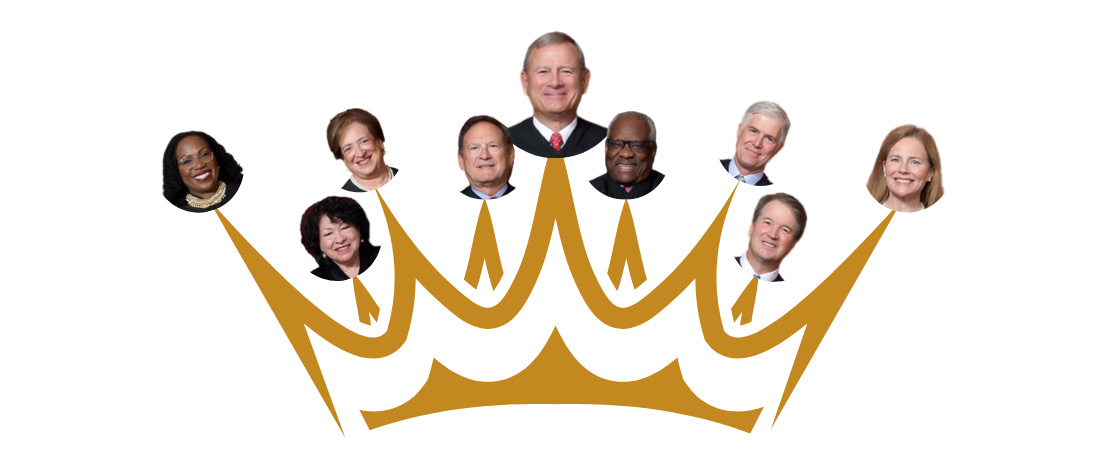
Chief Justice John Roberts’ metaphorical framing of judicial independence reflects the judiciary's perceived indispensability while asserting its sacrosanct nature. In his year-end report, Roberts extols judicial independence as vital to democracy, suggesting it deserves the same reverence and protection as the physical crown jewels of a monarchy. This metaphor exposes contradictions within the Court's contemporary role. Judicial independence may indeed be invaluable, but the crown jewels metaphor—laden with implications of monarchy’s infallibility, exclusivity, and guarded privilege—illuminates the Court’s problematic self-conception and its growing detachment from public accountability.
In a nod to legacy, Roberts borrowed the metaphor from former Chief Justice William Rehnquist’s year-end report 20 years ago. Rehnquist, often considered a Founding Father of “originalism,” championed the theory that the Constitution’s meaning is fixed at the time of its ratification. Yet, if this were true, it ignores the reality that constitutional interpretation is inevitably influenced by contemporary social, political, and personal factors, as judges cannot extricate themselves from the context of their own time. What Rehnquist envisioned is now the reality: a majority “originalist” Court.
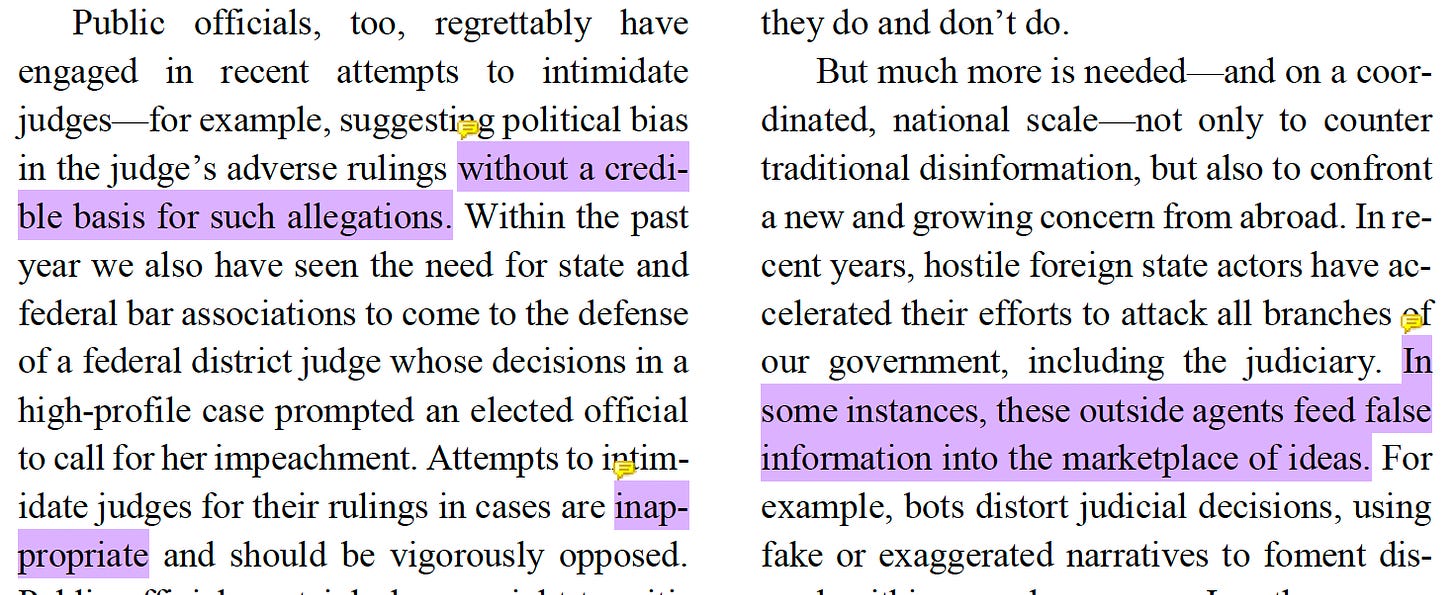
Calling judicial independence “crown jewels” evokes a monarchical imagery. For adherents of originalism and textualism—terms fraught with ironies and contradictions themselves—such treasures symbolize authority, continuity, and national heritage. Roberts stresses this idea, writing, “Hamilton anticipated that the relatively weak judicial branch—possessing neither the sword nor the purse—would require 'all possible care . . . to defend itself' against the attacks of the other branches” (3). Later in the report, Roberts extends this argument, condemning critiques from politicians “suggesting political bias in the judge’s adverse rulings without a credible basis for such allegations” (7). However, this stance appears inconsistent with his earlier insistence that the judiciary is open to informed criticism, as long as he need not directly address it.
The Crown Jewels and Public Accountability
The metaphor also reveals deeper assumptions about the Court’s self-perception. While crown jewels inspire reverence, they also signify untouchable privilege, suggesting a judiciary positioned above critique—a concept incompatible with democratic accountability. Roberts extends this metaphor to assert the moral superiority of the judiciary, framing lifetime appointments as essential safeguards of independence while sidestepping critical issues like justices’ refusal to recuse themselves in cases of clear conflicts of interest. Further undermining his argument, Roberts selectively cites liberal justices like Earl Warren and Ruth Bader Ginsburg to lend his position an air of timelessness and bipartisanship. His rhetoric glosses over mounting concerns about ethical lapses and a lack of transparency, which tarnish the Court’s image as a guardian of democracy.
John Roberts makes insulating the Court from criticism a central tenet of his argument, delineating what constitutes “legitimate” versus “illegitimate” criticism. He writes, “I feel compelled to address four areas of illegitimate activity that, in my view, do threaten the independence of judges on which the rule of law depends: (1) violence, (2) intimidation, (3) disinformation, and (4) threats to defy lawfully entered judgments” (5). However, juxtaposed with controversial decisions like Dobbs v. Jackson Women’s Health Organization, this framing highlights the tension between judicial independence and public accountability. The Court’s willingness to overturn Roe v. Wade, despite consistent polling showing majority support for abortion rights, reinforces the perception of the judiciary as an unassailable institution cloaked in independence to override democratic will. This rhetorical strategy risks alienating the public, portraying the judiciary as insulated rather than engaged with the nation it serves.
Lifetime Appointments and Politicized Processes
The idea that judges are not political actors is false to anyone paying attention, and denying it is absurd: While Roberts praises judicial independence as vital to democracy, his “crown jewels” metaphor recalls a time when power was inherited and unchecked. It underscores the reality of lifetime appointments, which now last far longer than the framers of the Constitution could have foreseen. In 1776, life expectancy was shorter, and judicial terms averaged about 14 years. Today, justices often serve for decades, shaping law and society long after the political conditions of their appointments have passed. This challenges democratic change, as a judiciary fixed in its views outlasts shifts in public opinion. To be fair, “no man may be sure that he may not to-morrow be the victim of a spirit of injustice, by which he may be a gainer to-day” (Hamilton qtd. in Roberts 4). Still, the problem grows with openly political tactics like Mitch McConnell’s control of nomination processes or justices retiring strategically to preserve ideological influence. Adding to this is the Court’s role as the primary authority on constitutional interpretation, a function once shared more evenly across branches.
Ethical Lapses and Internal Threats
The metaphor’s emphasis on protection raises additional concerns about the Court’s priorities. While Roberts warns of external threats such as violence and disinformation, internal threats—like ethical lapses and ideological rigidity—pose greater risks. Recent controversies, such as Justice Thomas and Justice Alito’s failure to disclose luxury gifts from billionaires undermine public trust. These ethical lapses paint a picture of justices prioritizing privilege over the rule of law.
The crown jewels metaphor also ties judicial independence to national identity, casting it as a reflection of American legal and cultural heritage. Much like the British Crown Jewels symbolize the monarchy’s grandeur and sovereignty, Roberts’ analogy tries to frame the Court as a revered cornerstone of democracy. However, this framing conflates independence with infallibility. While Roberts himself acknowledges the Court’s fallibility, he insists on its ultimate authority to interpret the Constitution. This mirrors the monarchy’s claim to divine right: power tempered only by self-restraint. Such framing risks deepening the legitimacy crisis Roberts seeks to address.
Resist or Embrace?
The metaphor underscores the paradox of modern judicial independence. While it emphasizes the value of an impartial judiciary, it also reinforces an image of exclusivity and infallibility that undermines democratic legitimacy. Roberts’ use of the “crown jewels” metaphor may be more thoughtless than thoughtful, unintentionally invoking a monarchical imagery in an attempt to frame judicial independence as simply important. But the reality is that only a moment of thought creates clashes with the ideals of a democratic system built on accountability and shared governance. This framing risks alienating a public already skeptical of the judiciary's impartiality by portraying the Court as unassailable rather than engaged with the nation it serves.
Even if Roberts’ metaphor reveals an issue that demands attention. How the judiciary conceptualizes its independence—and how it communicates this to the public—shapes the legitimacy of the entire justice system. By choosing a metaphor that evokes privilege and detachment rather than responsibility and transparency, Roberts inadvertently fuels the perception of a judiciary insulated from democratic principles. This discussion, as this post seeks to initiate, is necessary to confront these challenges and encourage a judiciary that safeguards its independence while remaining meaningfully connected to the people it exists to serve. Without such introspection, the judiciary risks becoming not a treasure to uphold but a relic to critique, increasingly estranged from the democratic values it purports to protect.
Further reading
Brock, David. 2024. Stench: The Making of the Thomas Court and the Unmaking of America. New York: Penguin Press.
Gallup. 2024. "Americans Pass Judgment on the Courts."(https://news.gallup.com/poll/653897/americans-pass-judgment-courts.aspx)
Geidner, Chris. 2024. “John Roberts attacks court criticism that he decides lacks a "credible basis" as "illegitimate." Law Dork. (https://www.lawdork.com/p/john-roberts-attacks-court-criticism).
Willis, Jay. 2023. "The Supreme Court 'Ethics Code' Is Weak Because the Conservative Justices Wanted It That Way." Balls & Strikes. (https://ballsandstrikes.org/ethics-and-accountability/supreme-court-ethics-code-weak/).
This week in metaphor
On Monday, January 6th, a day otherwise insignificant, The Guardian wrote an article about virtual employees:

Ah, “virtual employees”—a stroke of linguistic genius where Marx’s surplus value gets a glow-up as AI replaces workers while pretending to be one of them. These aren’t colleagues; they’re capitalist avatars, doing the bidding of the boss without the inconvenient need for paychecks or pesky organizing. It’s a classic move from capital: turn tools into pseudo-laborers, mask their function, and hope nobody notices the power shift. But sure, let’s call it “employee of the month” when the algorithm hits its targets. Be better, The Guardian.