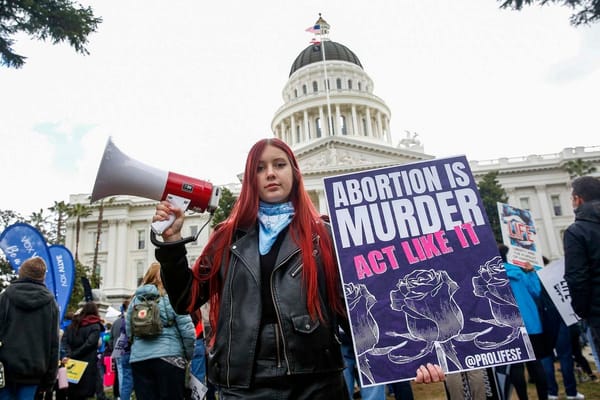
Violence by and against corporations
Shooting someone in the back is violence. But what about denying someone healthcare? In a world where the actions of corporations harm individuals, what counts as "violence" becomes unclear.

We think about violence a lot in the USA. It is literally a part of our every day lives. Last year there were 504 mass shootings (GVA); over half of Americans have either experienced gun violence themselves or know someone who has (SurveyUSA 2018, KFF 2023). But this post isn't about gun violence. There is more than enough written about that. This post is about how we define violence in general, what types of harm are like violence, and what types are something else.
At the end of 2024, Americans were confronted by this question very directly. Luigi Mangione (allegedly[1]) shot dead UnitedHealthcare's CEO Brian Thompson at point blank range, in the middle of Manhattan, in daylight. And, importantly, in apparent retribution for the violence wrought by the health insurance industry in America.
Amidst the immense coverage of this event, the op eds, and media frenzy, one particular quote in a Guardian article stood out to me.
“Commentators and talking heads don’t seem to understand the reaction because they don’t see these industries as violent ones,” Ongweso continued. They clearly understand that someone was murdered, he said, “but struggle with the idea that the population views what these companies do is murder on an industrial scale”.
- The Guardian, Rage, race and good looks: the forces behind the lionization of a murder suspect, 15 Dec 2024
From a cognitive linguistic perspective, this points to violence as an essentially contested concept — something of cultural significance that can come to be defined differently by different people in different contexts. There are prototypical "exemplars", instances we can all agree on (shooting someone, for instance, is definitely an example of violence), but the periphery is subject to constant negotiation.
It is this periphery I'll be considering. What do different forms of non-prototypical violence have in common? How does violence at the periphery come to be legally recognized as such or dismissed? And who benefits from that recognition or dismissal? We'll see that, of course, metaphor plays a huge role in this, especially through personification.
As far as I can tell, from intuition and a brief review of scholarly work, prototypical violence is direct and physical, involving three basic components: a (human) perpetrator, a (human) victim, and an intentional, nonessential, and harmful act by the perpetrator. Importantly, violence is also negatively valued, meaning that if something is “violent”, it is bad. Change one of the three basic components, and this negative valuing is no longer a given. Sport hunting, for example, is undeniably an intentional nonessential act by a human meant to harm another being. But the perceived “badness” of sport hunting, as a form of violence, hinges on us granting sufficient victimhood to non-humans.
When we consider whether or not a health insurance company unjustly denying healthcare coverage counts as “violence”, we can ask how far this act strays from the direct physical violence prototype. There is certainly a human victim, the person who cannot receive the healthcare they need. But things get murky when we look for a perpetrator and an intentional nonessential harmful act. If you ask a certain kind of business person for their opinion on the matter, Elon M*sk for example, you'll likely get a response something like this: no individual committed an act of violence because everyone was doing as company policy says, and that policy is to ensure profit, not to cause harm.
Let's dismiss that last part first. Our core components say nothing about the motivation behind an intentionally harmful act. If someone kills their sibling in order to get more inheritance, they still killed someone, even if killing someone wasn't their goal per se. So, sure, the company's policy isn't to harm people, but if the means of making profit necessarily involve acts of harm[2], then the company is still intentionally causing harm. Is that harm nonessential? I suppose that depends on whether the drive for profit can be equated to a physical need like eating or drinking water. I’m going to assume my reader doesn’t want to make that equivalency.
Okay, now the tricky part. If individuals (e.g. Brian Thompson) are acting on behalf of a company, who is intentionally and nonessentially causing harm? My suggestion is this: the company, metaphorically understood as a person, is causing harm, which comes to be metonymically understood as actions by real individuals. Here in the Metaphor Society, it is our job to question the legitimacy of this metaphor and its fallout metonymy.
Conceptualizing companies as people isn't all that interesting when there are real life individuals clearly in charge. Think Ma and Pa shops. The Ma or the Pa basically is the company. There’s metonymy here — the company is understood as the owner and other components of the company (e.g. employees) are backgrounded — but this is not metaphor. Where it gets interesting is with large companies, with corporations, like UnitedHealthcare, that establish an identity independent of the real life individuals involved.
When large privately owned companies became commonplace around the end of the 19th century, they posed a legal conundrum. Their dealings and misdealings had to be regulated in some way and the legal system was ill-prepared. The legal system could handle interactions between people, and between people and governments, but that’s it. In order to handle this strange new third entity, the corporation, the law could either borrow from what it already had, treating them as persons or governments, or it could take the time to come up with an entirely new set of definitions and relations. Treating corporations as something new was too hard (a “crisis of legal imagination”, according to Gregory A. Mark in a surprisingly entertaining overview of corporate personification) and treating them as governments was too threatening to the governments wanting to regulate them. And so we were left with one option — corporations would be treated as legal persons.
The treatment of corporations as legal persons was, initially, recognized as a kind of shorthand, a sloppy metaphor that made writing laws and deciding court cases a little bit easier. Everyone knew it was not a reality, of course corporations weren’t actual people. Like any institutionalized metaphor though, corporate personhood, through entrenchment and reification, became a reality.[3] By saying it over and over again, corporations became autonomous individuals with the rights and protections of naturally born people. As promised by the constitution, they were thus granted freedom of speech (Citizens United v. FEC, 2010)[4] and religion (Burwell v. Hobby Lobby Stores, Inc., 2014).
Theoretically, the corporate personhood metaphor should also enable the law to do things like hold companies accountable for person-like crimes (negligence, murder, etc.). It should allow us to judge companies by the same moral standards we judge individuals. It should allow us to stigmatize ethically suspect business practices as we stigmatize ethically suspect behavior. It should allow us to consider profit-seeking actions by corporations as acts of physical violence. By and large, it doesn’t.
Granting personhood to corporations was a legal convenience that backfired in a spectacularly predictable way. Corporations, with financial and material power well beyond that of the vast majority of individual people, continue to levy their resources to manipulate the definition of their “personhood”. They are like us in the ways that benefit them, but not in ways that would limit their economic interests.
Resist or embrace?
Some have tried to use the corporate personhood metaphor to progressive ends, by advocating for corporate social responsibility or by using it as a precedent for granting personhood to environmental entities and leveling the legal playing field between corporate and environmental interests. Given the current power of corporations, I think that the corporate personhood metaphor contains a much greater capacity for harm than good, and so should be resisted.
Corporations are not people and we are not corporations.
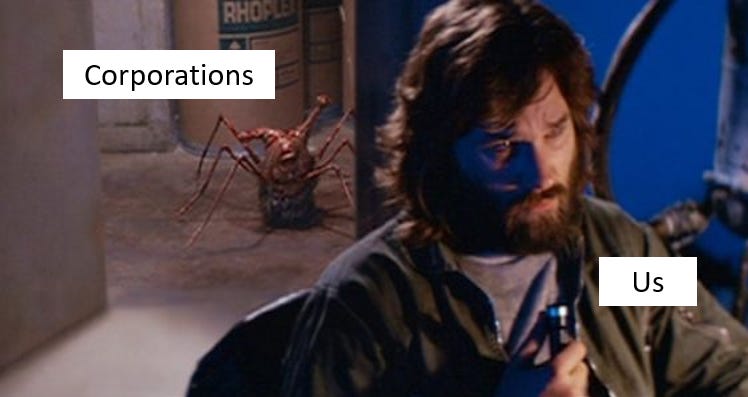
The literalization of the corporate personhood metaphor may encourage individuals to attempt to address corporate harm as if corporations were actual people. Regardless of the cultural symbolic heft killing a CEO may have, beheading a corporation doesn’t work. Despite all of the body metaphors in corporate speak (talking about their brains, hearts, and backbones, for instance), corporations are not people. They are not bound by the physical limitations we are. They replace their “heads” and “hearts” with little effect on their overall “health”.
Metaphor is also not unidirectional.[5] Accepting and perpetuating the corporate personhood metaphor quietly morphs the ways we conceptualize ourselves.[6] We are not corporations. We do not have an inherent profit drive, and we do not benefit from infinite growth (the closest thing to infinite growth in our real bodies is cancer). If we’re interested at all in challenging the extractive and exploitative systems driving inequality and ecological collapse, we have to challenge the corporatization of our selves.
Animating corporations may very well be helpful in conceptualizing what might otherwise be inaccessibly abstract. But this animation can’t be as people. We have to distance ourselves, our humanity, from the inhumane profit motives that drive corporate actions. In the end, this means that we may still be able to say that corporations are violent, but their violence is scary and strange, much more so than the violence committed by a person against another person.
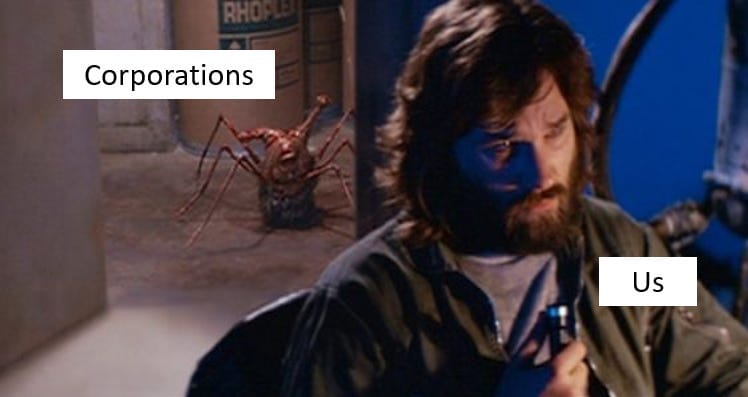
When we’re eager for a new metaphor, science fiction is often a great place to turn. John Carpenter’s The Thing (1982) seems to me an interesting (and entertaining) angle to try.[7] The titular Thing is an alien lifeform unlike anything on Earth, consuming all other life it encounters and morphing its appearance at will to evade detection and apprehension. The humans, committed more to altruism than their own survival, do everything in their power to stop the Thing-ification of Earth.
This week in metaphor
This post is a week late (apologies!) because I was in South Africa for two weeks, doing my best to avoid the news and social media. So here's a few found metaphors from my travels.
One. A Monterey Pine timber plantation on the edge of native fynbos habitat off the Tsitsikamma Trail. This is a metaphor for so much: the cultural destruction and homogenization brought about by colonization, the self-imposed and false division between the messiness of nature and orderliness of society. All that metaphoric darkness beneath a deceptively clear sky.

Two. That same Monterey Pine plantation from a different angle (literally and metaphorically). Without being able to compare this “forest” with the diversity and density of a healthy natural habitat, this may be seem like a beautiful scene. But then you step and look at just the right moment to see it for what it really is, a facsimile of a forest, stripped of its natural spontaneity and abiding instead by the straight logic of capitalist production.

Three. On a final uplifting note (questionable pun intended), a tree valiantly carrying impressively large stones skywards. Okay, I don’t actually know what this is a metaphor for exactly, but it seems hopeful, right?

If you really enjoyed this piece, please consider leaving us a tip. We don't believe in paywalls and are as sick of paid subscriptions as you are. So we don't even offer them. But it does cost money to keep this thing going and anything you have to spare helps ❤️
[1] In the legal sense, not the conspiracy theory sense.
[2] We could argue here about whether denying healthcare directly causes harm, which I've stated as a key aspect of prototypical violence. Isn't it really the pre-existing ailment causing harm after all? Perhaps this is better characterized as neglect, and is neglect really violence?… Arguing against this would take a while and lead us off track. But here's an analogy: if a firefighter came to your home and passively watched it burn, that would be a fairly shocking act of negligence (i.e. of not doing). Denying someone healthcare, as a supposed healthcare provider, isn't the firefighter watching your house burn though; it is the firefighter going up to the door and locking you inside a burning house.
[3] Within specialist circles, this “reality” is still debated. Lan & Heracleous (2010) have a helpful table outlining three frameworks for understanding the nature of corporations.
[4] Metaphorically, this one is pretty crazy. Given that corporations aren’t actual people, they also can’t, well, actually speak. So corporate “speech” isn’t speech at all, it’s the ability to spend massive amounts of money to sway elections...
[5] [UPDATE] A reader kindly reminded me that bidirectionality is contested in metaphor research. In many metaphor classrooms, and implicitly in much metaphor research, metaphor is understood as a fundamentally asymmetrical (i.e. unidirectional) process in which a source domain is mapped onto a target domain; the target domain is (re)understood using the conceptual structure of the source. Though I sympathize with the idea that particular instances of metaphoric expression may be unidirectional (or are at least intended to be unidirectional by the communicator), in this blog I am usually talking about metaphor as a cognitive and social practice, rather than as a series of independent communicative events.
I am generally aligned with constructivist approaches to social cognition. All concepts are inevitably entwined in the sociocultural contexts that the cognizer finds themselves in, and thus are under constant negotiation, reassessment, and reconstruction. In the corporate personhood metaphor, for instance, I take both the target (corporations) and source (persons) to be in flux as society constantly repositions each within our ever-shifting social structures. This means that each time we use personhood to understand a corporation, we reconsider the compatibility of the two concepts. Because this compatibility is always partial (the two concepts are distinct in the end), the process of mapping foregrounds particular aspects of both the target and source. In doing so, our understanding of both concepts shift, even if only by a little bit, and even if it is not what we intend.
For an even lengthier discussion of this kind of approach see: Danesi, M. (2017). The bidirectionality of metaphor. Poetics Today, 38(1), 15-33. https://doi.org/10.1215/03335372-3716201
[6] For a nice discussion of this (and the corporate personhood metaphor more generally), see: Kirsch, S. (2014). Imagining corporate personhood. Political and legal anthropology review, 37(2), 207-217. https://www.jstor.org/stable/24497486
[7] People too often dismiss The Thing as a simple gory B-movie. There’s a subtly sophisticated class and racial commentary in it though, I swear.